Article writer-Valenzuela Delaney
The most recent laser modern technology allows us to make a thinner corneal flap, which is much faster and easier for patients to heal. This likewise lowers issues like glow and also halos from the edges of the treatment zone.
Traditionally, this flap was produced with a microkeratome, which had specific risks. https://www.privatehealth.co.uk/articles/cataract-operation-pros-and-cons-82031/ make use of a femtosecond IntraLase laser to develop the flap, which is a lot more exact as well as more secure.
The Femtosecond Laser
Historically, traditional LASIK surgery used a mechanical cutting device called a microkeratome to develop a hinged flap on the cornea. The doctor after that folded up back the flap to access the eye's underlying cells. The specialist after that used an excimer laser to improve the corneal tissue, correcting refractive errors like nearsightedness and farsightedness.
The femtosecond laser used for LASIK treatments provides considerable advantages over standard tools, including increased safety and security, better recovery, and accurate results. The femtosecond laser's powerful pulses of light disrupt the corneal tissues in an exactly regulated way.
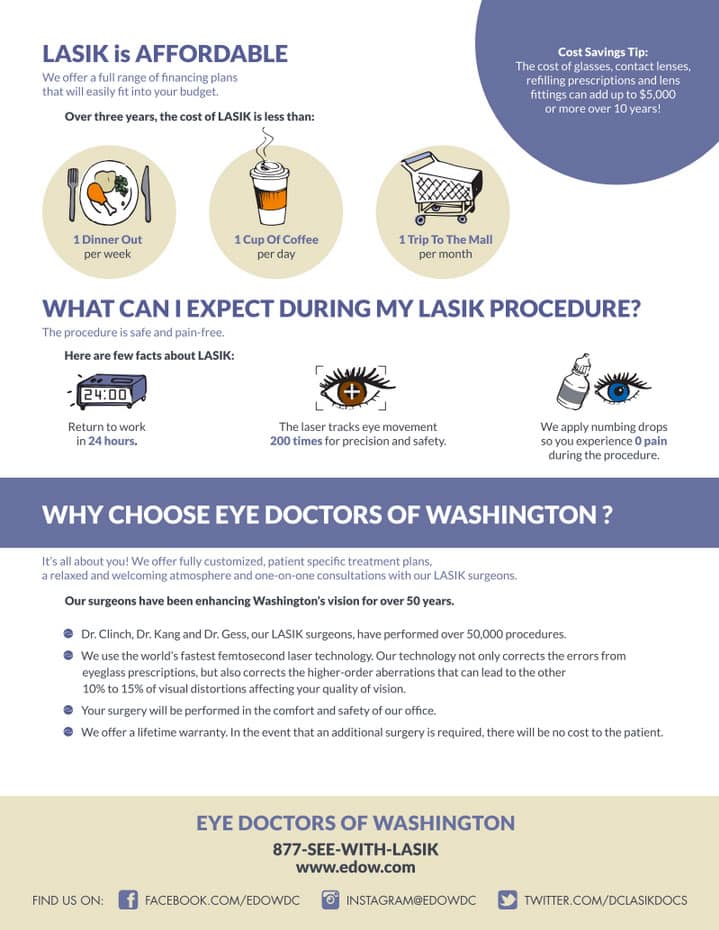
The femtosecond laser's clever power control additionally enables doctors to track eye movement 200 times per 2nd, which ensures that every laser pulse is entirely exact. This enables surgeons to do best lamellar and also penetrating keratoplasties in addition to clear corneal lacerations, cataract surgery, and much more. The outcome is a customized therapy that offers clients with exceptional visual outcomes. In fact, several New York City laser eye surgeons contrast the individualized results to those attained with get in touch with lenses as well as glasses.
The IntraLase Flap
The first step of the LASIK procedure involves creating a flap on the corneal epithelial surface. Traditionally this was performed with a hand-held bladed instrument known as the microkeratome. Considering that the microkeratome makes physical contact with your eye, it can present an aspect of threat to the surgical procedure.
The femtosecond laser is much safer for this crucial first step of the LASIK procedure since it does not make physical contact with your eye. Rather the femtosecond laser develops a pattern of tiny bubbles below the corneal surface that after that attach to form the flap.
This brand-new strategy permits the specialist to establish precise criteria for the flap thickness, depth and hinge place. https://telegra.ph/The-Latest-Developments-In-Lasik-Eye-Surgical-Procedure-Modern-Technology-06-07-3 offers the specialist with a high degree of modification that eliminates problems connected with the flap and also ensures an extra successful LASIK result. It additionally enables more individuals with slim corneas, who were disregarded as LASIK candidates in the past, to receive the treatment as well as appreciate improved vision.
The SMILE Treatment
The FDA has simply authorized a brand-new refractive surgery procedure that is an alternate to LASIK called little cut lenticule extraction (SMILE). It is an excellent laser therapy option for patients with myopia, or nearsightedness.
Throughout the SMILE procedure, a Visumax femtosecond laser produces pulses that will certainly define as well as develop a synopsis of a slim lens-shaped item of corneal cells, called a lenticule. The surgeon then produces a keyhole cut on the corneal surface, and also eliminates the lenticule to improve the cornea and appropriate vision.
The truth that SMILE does not require a flap might help to minimize dry eye signs after the procedure, and it likewise appears that the small lenticule incision triggers less damage to the corneal nerves, leading to much better biomechanical stability over time. These benefits, in addition to the truth that SMILE treats a broader range of nearsightedness problems than keratomileusis does, make SMILE an enticing option for lots of individuals.
The Excimer Laser
The excimer laser utilizes ultraviolet radiation to change the corneal shape, lowering refractive errors such as nearsightedness (nearsightedness), hyperopia (farsightedness) and also astigmatism. It is the most important piece of equipment in Lasik surgery and also the trick to eliminating your dependence on glasses and call lenses.
Excimer lasers make use of a mix of two gases, typically argon fluoride or krypton fluoride to create a beam of ultraviolet light which can be specifically focused. This allows the laser to disintegrate the carbon-to-carbon bonds in the corneal tissue without triggering any type of damage to other neighboring eye cells.
Unlike previous excimer lasers, the WaveLight EX500 has incorporated non-contact real-time pachymetry, which offers Dr. George instant comments on the development of your therapy, ensuring that your corneal thickness is being properly decreased as intended. This helps the physician know that the femtosecond laser is developing the flap at the correct fixed density, and also validates that the ablation volume is being reduced as anticipated to treat your specific refractive mistake.